

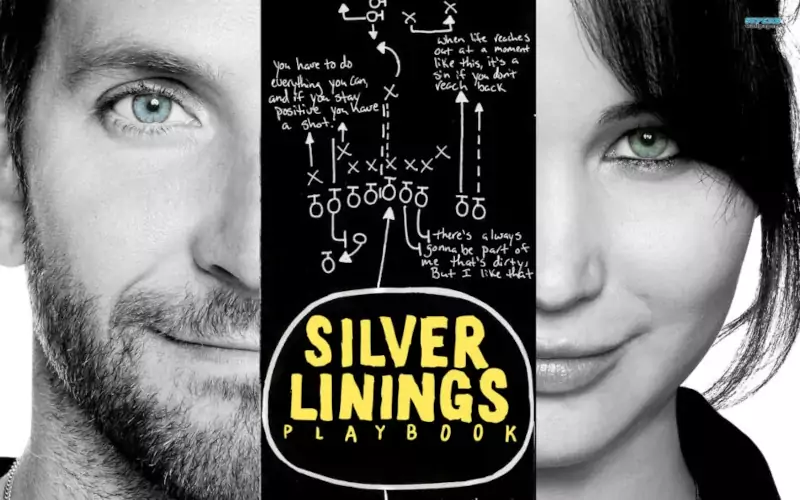
Author Sally Kempton once said, “it’s hard to fight an enemy who has outposts in your head.” This concept is made readily accessible in ‘Silver Linings Playbook’.
Not to be defeated by his stay in a neurology hospital after catching his wife in an affair and nearly killing her lover (an event he can’t remember), Pat moves in with his parents to put his life back together, hoping to reconcile with the unfaithful Nikki. With tunnel-vision optimism, Pat views the world as a movie that is bound to have a happy ending; if he can correct the things about himself she found at fault, he knows Nikki will take him back.
He begrudgingly finds a kindred spirit in Tiffany, a widow who has also recently moved back home after the death of her husband and who is struggling with depression. The two inch around a tentative friendship, with her agreeing to help him connect with his wife in exchange for his partnering with her in a dance competition. Together, they find ways to manage their demons and even move beyond their pasts into something better.
This book is a love letter to people suffering from mental illness, offering them a vehicle through which to make their lives accessible to others; be they friend, family, or stranger. Pat and Tiffany are not caricatures; they could be your brother or sister. Their symptoms are not used as fodder for jokes, or trivialized. Instead they are presented in the midst of recognizable family dynamics so that their family begins to look like our family; their fears look like our fears and their wants, our wants.
Written in first person, from Pat’s point-of-view, the style is unusual and almost childlike, but the simple and straightforward manner of communication is endearing. Pat is a man with a mission – holding desperately to an ‘if I think about it and wish for it hard enough and long enough it has to come true’ state reminiscent of childhood with an earnestness that is heartbreaking in light of the reality around him.
The book could have easily become weighted down by depth of emotion or heavy themes, but just as the clouds seem thickest, reality proves to be the promised silver lining. Author Matthew Quick wrote this for his son, who has struggled with mental illness, for the very purpose of making those like him less stigmatized. Quick succeeds admirably, and the translation of book into film only furthers that cause.
Actor Bradley Cooper, who plays the role of Pat in the movie adaptation, spoke at a press conference sponsored by the Center for American Progress last February, where he admitted that before making ‘Silver Linings’, he was “ignorant” about mental illness, but his experience has inspired him to raise awareness. The movie itself has opened up a national dialogue about mental health, and adds to its distinctions the honor of being the first movie in over thirty years to have earned The Big Five Academy Award nominations (Best Picture, Best Director, Best Actor, Best Actress, Best Screenplay), plus all acting categories, and a win for Jennifer Lawrence for Best Actress as Tiffany.
‘Silver Linings’ is also an excellent case study for adapting books to screenplays, as the main plot of the movie is just one facet of the book’s overall story. It is easy to understand, in reading the book, why it was thusly trimmed, and comparing the two works side by side would be a helpful learning aid in how to capture the essence of a story and make it appropriate in a different format without losing its message or heart.